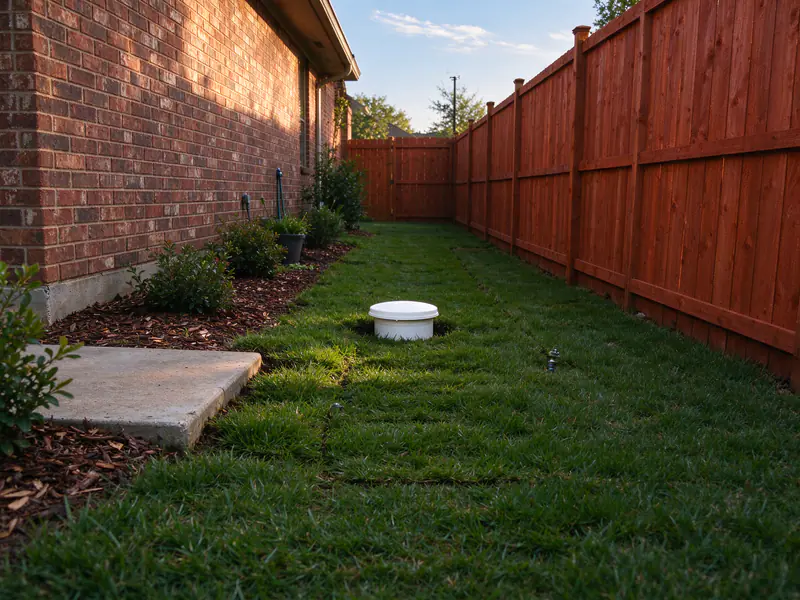
A French drain moves water that is traveling through the soil. Built in the right place with a real outlet, it dries a soggy side yard for good. Built in the wrong place, it fills with clay and holds water.
A French drain is the right tool for one specific problem: water that soaks through the soil and lingers there. It is not the right tool for every wet yard, which is why Rein Irving Drainage Company starts every French drain estimate by confirming two things on site. First, that the water really is moving through the ground rather than sitting on top of hard clay. Second, that there is an outlet lower than the trench, so the water has somewhere to go once the pipe collects it.
When a French drain is the answer
French drains suit ground that stays soft for days after rain, a side yard that never dries, seepage coming down a slope, and water arriving underground from a higher neighboring lot. If you are not sure which kind of wet yard you have, our page on standing water in the yard helps sort it out, and a whole-yard drainage plan handles yards with more than one source. In each case the water is already in the soil, and a gravel trench with a perforated pipe gives it an easier path than the surrounding dirt.
They are a poor fit for a puddle sitting on clay. If water stands on the surface and the soil a few inches down is dense and dry, the water cannot reach a buried pipe quickly enough. That yard needs a catch basin or regrading first, and sometimes a French drain as well. Our guide on French drains versus catch basins walks through the difference.
Why Irving soil changes the design
Irving sits on two very different kinds of ground, and they call for different French drains.
Las Colinas and much of north Irving map as Ferris and Heiden clay in the USDA soil survey: about half clay particles, with a shrink-swell rating near the top of the scale and water entering the soil extremely slowly. A drain here mostly intercepts water moving along the top of the clay, so it stays shallow and relies on good fabric.
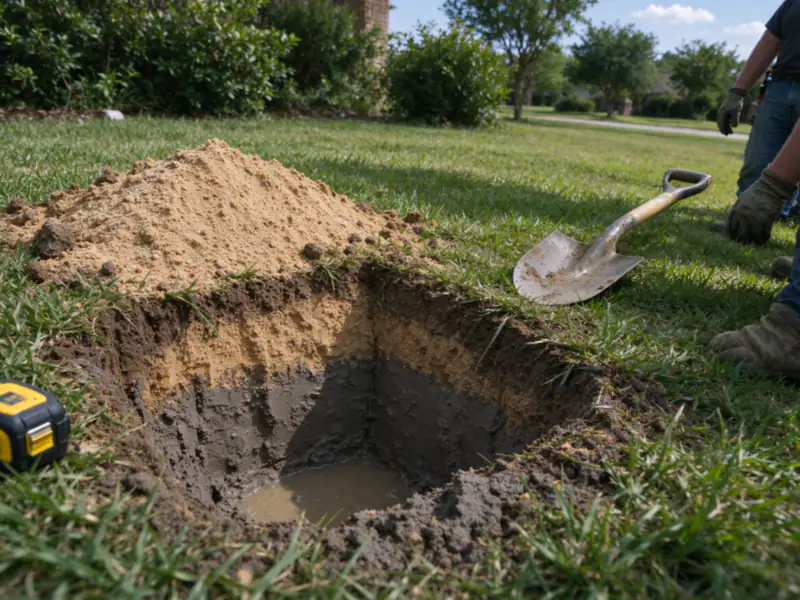
Central and west Irving map largely as sandy loam over clay. Near Irving Boulevard the top 15 inches are loamy fine sand over a sandy clay loam; in Plymouth Park, about 8 inches of sandy loam sit on clay that is 45 percent clay particles. Rain sinks through the sand and stops on the clay, so the lawn stays soggy. A shallow drain laid along the top of the clay line works well in this ground.
Low ground near the Trinity and the creek bottoms maps as floodplain clay. Outlets there can sit higher than the yard, which sometimes means a sump and pump instead of a gravity line.
The soil survey describes a sample point, not your lot. That is why we dig a test hole before choosing depth and fabric. The longer explanation is in French drains in clay soil.
How a French drain is built properly
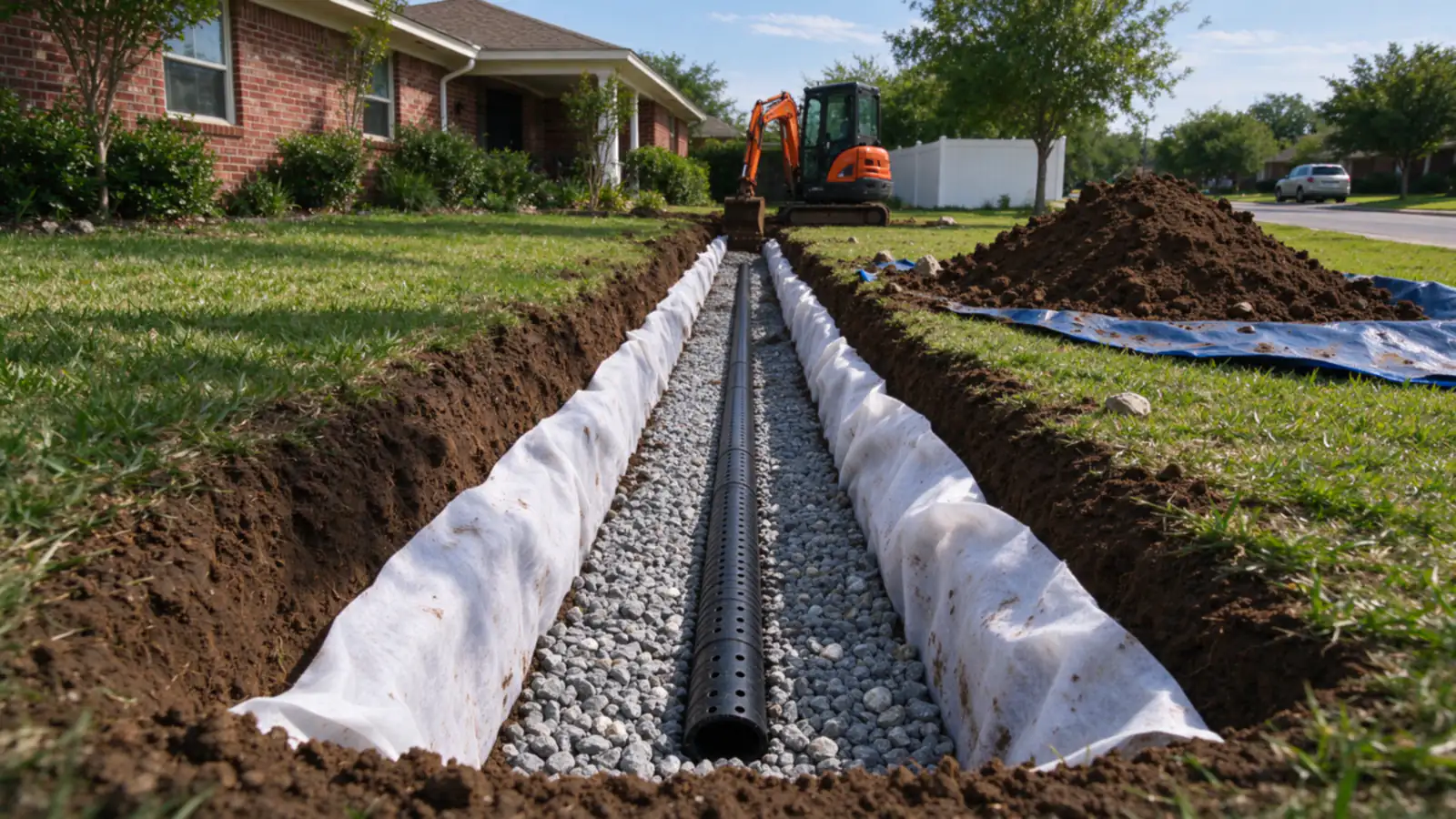
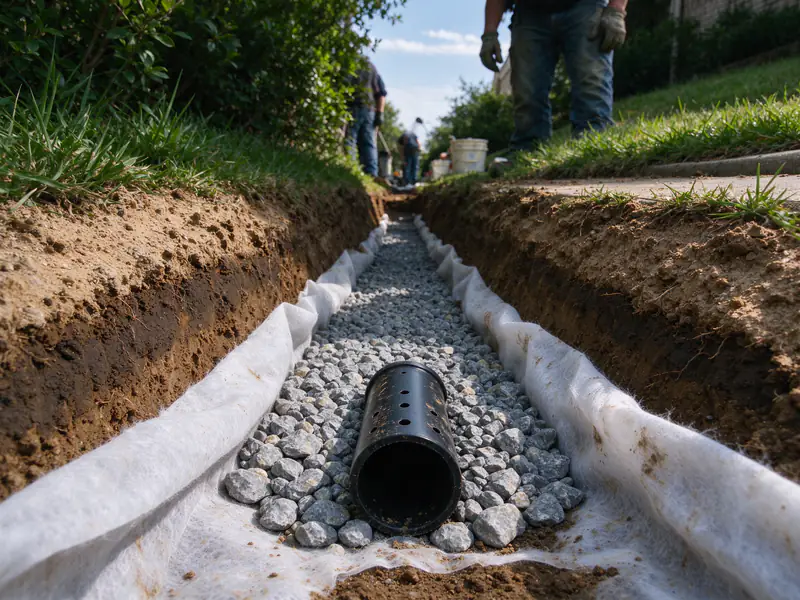
Every layer has a job, and skipping one is the most common reason drains fail.
Layer
What it does
What goes wrong without it
Trench at a set fall
Carries water downhill to the outlet
Water pools in flat spots and silts the pipe
Nonwoven filter fabric around the stone
Keeps clay fines out of the gravel
Stone clogs with clay, often within a few years
Clean washed stone
Gives water an open path to the pipe
Fine material slows flow to a trickle
Rigid perforated pipe
Moves collected water quickly
Thin sock pipe crushes and silts
Solid pipe to the outlet
Carries water past the house without leaking it back
Water re-enters the soil near the slab
Cleanout at turns
Lets the line be flushed later
A clog means digging the line up
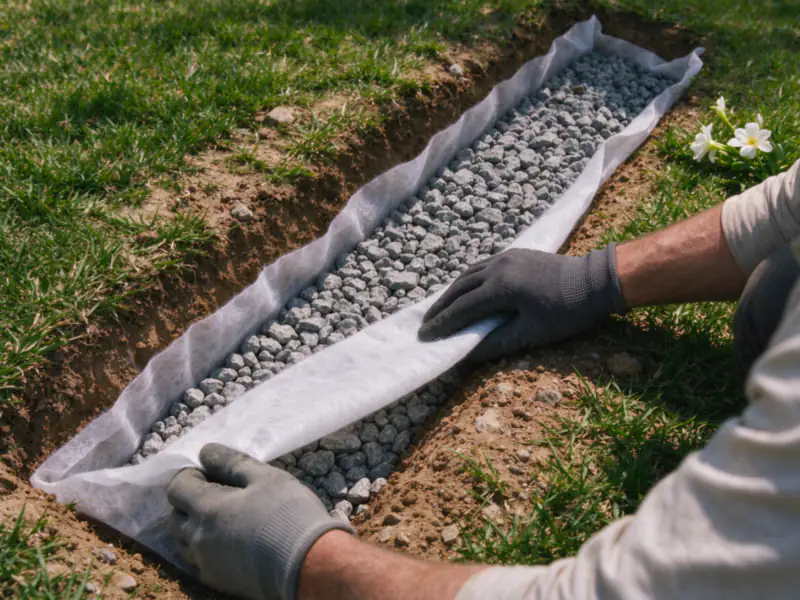
We keep the fabric around the stone, not just a sock on the pipe, because in clay the sock is where the fines collect first. Where a drain runs along a fence line to catch water coming from a neighbor’s yard, it works as an interceptor, sometimes called a curtain drain. The build is the same; the placement is what changes.
The outlet comes first
A French drain is only as good as the place it empties. The common choices around Irving are a curb core through the street curb, the alley line, a grassed swale, a pop-up emitter in a lower part of the lawn, or a pump where no gravity outlet exists.
The rules differ by city. University Park requires roof drainage to be piped through the curb or to the alley line. Coppell has issued curb cores for yard drains as engineering permits. Grand Prairie prohibits concentrating runoff onto a neighboring lot without an easement or a recorded release. For Irving, we confirm the requirement for each address before work starts. Statewide, Texas Water Code section 11.086 makes it unlawful to divert surface water in a way that damages another property, so a drain can never simply be aimed at a neighbor. More detail is in where a French drain can drain.
Depth and fall
Depth follows the outlet rather than a rule of thumb. Most yard runs sit 12 to 24 inches down, with the pipe falling steadily from the far end to the outlet. Where the outlet is far away or barely lower than the yard, the trench gets deeper toward the outlet, which adds digging and cost. On a very flat lot with no lower point at all, a pump is the honest answer.
What it costs
A typical Dallas-area range for a standard exterior French drain is about $25 to $55 per foot installed. That covers the trench, fabric, stone, perforated pipe and a basic outlet. The figure moves up with depth, a long run to the curb, roots, concrete that has to be cut, and the amount of sod and sprinkler line to restore. The full breakdown, with example budgets, is in French drain cost in Irving, and the cost tool gives a range for your own length without a phone call.
How the job runs
Locate. An 811 utility locate request goes in before any digging, and paint and flags appear in the yard a few days later.
Layout. The trench line, depth at each end and the outlet are marked, and sprinkler lines in the way are noted.
Trench and build. The trench is cut to grade, lined with fabric, bedded with stone, and the pipe is laid and checked for fall.
Test. Water is run in at the far end and watched at the outlet before anything is covered.
Restore. Stone and fabric are closed over, the trench is backfilled, sod is re-laid and crossed sprinkler lines are repaired. Spoil that cannot go back is hauled away.
Rein Irving Drainage Company plans and manages each job; installation is carried out by licensed and insured drainage contractors we work with.
Keeping it working
A French drain built with fabric around clean stone, smooth pipe and a free outlet needs little attention. Check the outlet after big storms, keep mulch and soil from burying it, and flush the line through its cleanout if the ground over it starts staying wet again. If an older drain has already stopped working, drainage repair starts by finding out why, and how long a French drain lasts explains the warning signs.
What this work looks like
French drain trench lined with filter fabric, washed gravel and perforated pipeGloved hands folding nonwoven filter fabric over a gravel-filled French drain trenchTest hole in a lawn showing sandy topsoil over dense clay with water seeping at the clay lineFinished French drain line in a side yard with a white cleanout cap in the lawn
Questions people ask
How deep should a French drain be in Irving?
Most yard runs sit 12 to 24 inches deep, but the depth is set by the fall needed to reach the outlet and by where the clay starts. In central Irving, where sandy topsoil sits on clay about a foot down, the trench usually follows the top of the clay.
Can a French drain go next to the foundation?
It can, but depth and distance matter. A deep trench close to a slab on expansive clay can dry one side of the soil faster than the rest, so drains near a house are kept shallow or set back, and a foundation engineer's view comes first where the slab already shows movement.
What pipe should a French drain use?
Rigid perforated pipe in clean washed stone wrapped in nonwoven filter fabric, with solid smooth pipe from the end of the collection zone to the outlet. Thin corrugated pipe in a fabric sock crushes and silts up quickly in clay.
Does a French drain need a permit in Irving?
The trench on your own lot often does not, but an outlet through the street curb is work in the right-of-way and usually needs city approval. For Irving addresses we confirm the requirement before work starts.
How do I know a new French drain is working?
Before backfill, water poured in at the far end should flow out at the outlet. After the first heavy rain, the ground over the line should firm up within a day and the outlet should show flow.
Find out if a French drain is the right fix.
Send a photo of where the ground stays wet and your address.